
I’ve been thinking a lot about how I got here. Not just dealing with dysautonomia—autonomic dysfunction—related to post-acute infection syndrome (PAIS or Long COVID), but the road that led me to this place.
In April Amanda and I flew to New York City for a week of testing and appointments at Mount Sinai’s Cohen Center for Recovery of Complex and Chronic Illness. My team at Mount Sinai (and at home in Montana) believe that overtraining was an important piece of the puzzle. Big training blocks, more volume, more intensity, I was clearly flirting with overtraining before I got COVID.
Looking back, after doing a lot of work with my health coach, my counselor, and on myself, I see that it was more than training volume that got me in trouble; it was a mindset.
You see, I’m really good at pushing myself. I’ve developed a strong ability over the years as an athlete to dig deep and push beyond a migraine, fatigue, inflammation.
For most of my athletic and professional life, this ability to push served me. It’s how I’ve overcome chronic migraine, ankylosing spondylitis, chronic tendinopathies, a crazy rare clotting disorder. It’s also how I banged out three books, with discipline, focus and a relentless spirit to do more and be better.
But somewhere on my journey I got way better at listening to the Guru of Go voice, that part that needs to go than the slow down or that’s enough for today part.
I think this is an important conversation to have in the endurance community.
I’ve often said I’m the Guru of Go and when I can’t go, I get low. So, I just keep going, because who wants to get low?
I know there’s a lot of athletes out there with similar wiring or programing. Let’s face it, our endurance culture celebrates an ability to push on beyond just about anything else.
It’s easy to conceptualize the idea that stress is stress and that it all goes in one bucket—but try telling that to an athlete with 40 years of pushing under their belt. Training feels like the release, the refuge, the escape, not the stress. But I’m learning there’s a fine line between getting stronger stress and pushing your body to give more than it has to give.
I crossed that line.
I don’t know if overtraining is what caused what I’m dealing with now. I don’t think anyone can answer that for certain. But my team and I believe it’s an important part of the story.
And now, as I navigate post acute-infection syndrome (Long COVID), dysautonomia and mitochondrial dysfunction, I’m needing to rethink my relationship with training, recovery and my body.
This has been humbling and at times daunting. A rebuild if you will.
The mindset that helped me be the athlete I was, isn’t necessarily the mindset that’s going to help me be the athlete I want to become in the future.
For me, pulling back, not pushing, is far harder.
Perhaps the biggest lesson I’m learning, is that it would behoove me to leave something in the tank at the end of the day.
There’s wisdom in stopping, in slowing down, in doing less, in taking time to fully recover. Sometimes slow is fast and less is more.
As my counselor who knows me awfully well likes to remind me, it sure is fun to empty the tank from time to time, but right now, my tank can’t afford to be emptied.
WNbL, mwl
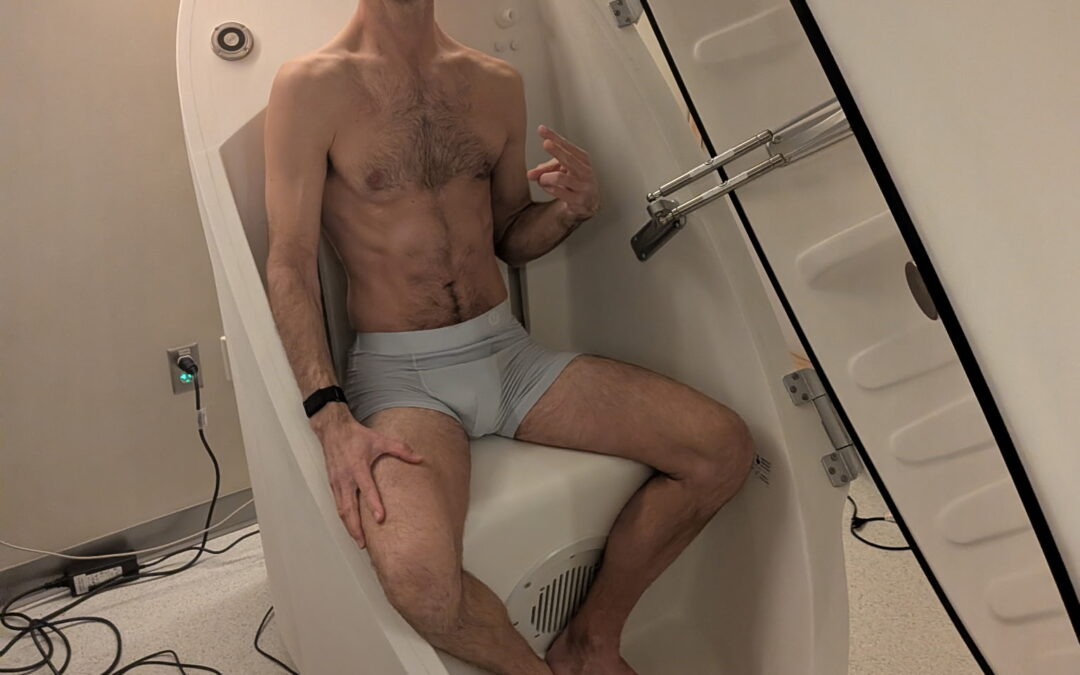
PS: If you’re wondering about the swim cap and the Lulu undies, that’s the Bod Pod I’m climbing into at Mount Sinai’s Center for Recovery of Complex and Chronic Illness. This test helped uncover the mitochondrial dysfunction and resting metabolic rate issues I’ve been having since my COVID infection.